
With the aim to foster competitiveness and to propel the States and Union Territories to work proactively towards promotion of their startup eco-systems, the States Startup Ranking Framework was launched by Department of Industrial Policy and Promotion (DIPP) on 6th February 2018. The ‘State/UT Startup Ranking Framework’ is spread across 7 areas of interventions with a total of 38 action points and overall score of 100 marks.
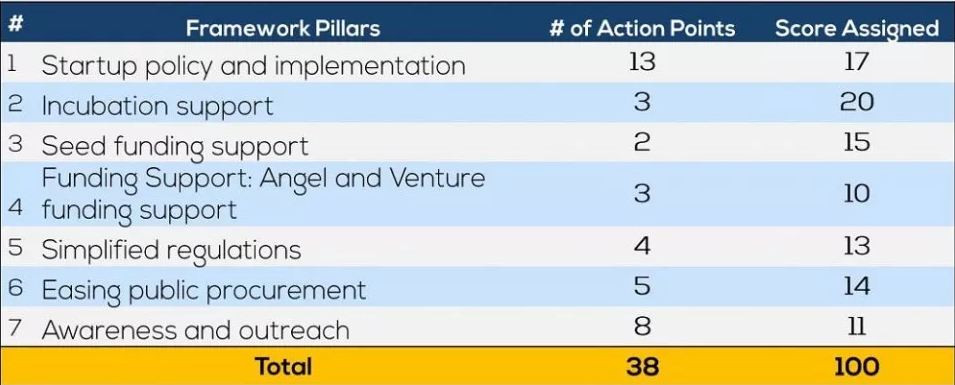
In order to evaluate States/UTs in a balanced and transparent manner, the implementation of action points by the State/UT Government and feedback from Startup ecosystem components have been given due weightage. Under the framework, out of 38 action points, 21 action points require submission of supporting document(s) by the State/UT Government, 1 action point requires only stakeholder feedback and 16 action points require both the components (supporting document(s) and stakeholder feedback) for assessment of the State/UT Startup initiatives. For example, one of action points in pillar of Startup policy and implementation is Women Entrepreneurship, which is to check whether State/UT provides benefits or incentives to encourage women entrepreneurship, and there are 2 guidelines:
State/UT Startup policy should provide benefits and incentives (fiscal and/or non-fiscal) for encouraging women entrepreneurship.
At least 25% of total beneficiaries of State/UT Startup policy should be for women entrepreneurs (founders and/or co-founders) in last two years. And the assessing method is the supporting documents provided by the State/UT Government on the one hand , and feedback provided by ecosystem stakeholders on the other.
In 2017, DIPP appealed stakeholders to share their feedback about the states in implementing their startup policies until March 2018.The said stakeholders include startups, mentors, investors, accelerators, incubators and the government bodies. A feedback mechanism has been opened on the official website of Startup India. The ranking framework has 3 goals as following:
Help bring to fore progress made by the States/ UTs for promoting Startup ecosystem.
Foster competitiveness and propel the States/ UTs to work proactively.
Facilitate States/ UTs to identify, learn and replicate good practices.
With the State Startup Ranking framework in place, it will be interesting to watch what actions the states will now take to improve their ranking and who will get into the top 10 startup ecosystem list of DIPP.